
Tax Loss Harvesting in Indian Stock Market: Complete Guide to Offset Capital Gains
- Valuenomy Research
- Taxation
- 07 Sep, 2026
Understanding Tax Loss Harvesting
For any Indian stock market investor, your real gains are calculated on post-tax basis. Most individual investors keep checking profit and loss in the balance sheet without understanding the final tax implication.
Tax loss harvesting is a method given under the Income Tax Act of 1961 where investors can offset their capital gains. The principle is quite simple. Sell those underperforming scrips/mutual funds/ETFs in your portfolio before 31st March and save a big chunk of money in taxes.
How the Strategy Actually Works: With an Example
Let us say that you made a profit of 3,00,000 rupees by selling your mid-cap stocks that you held for a period less than 12 months. These are short-term capital gains and you are supposed to pay 20 percent tax on it. That amounts to 60,000 rupees in tax that has to go to the government.
Now, in the same portfolio, you have another stock that is at a loss of 1,50,000 rupees.
If you keep that stock as is and do nothing till March 31, you will ultimately have to pay 60,000 rupees in taxes on March 31 when you square off your profitable trade.
However, if you sell that stock before March 31, you can actually save 30,000 rupees in taxes. Here is how it works.
Under the Income Tax Act, you can set off a loss against a profit. So, the 1,50,000 rupees loss that you incurred on a stock before March 31, you have the right to adjust this against the 3,00,000 rupees profit on your mid-cap stocks. After adjusting, a net profit of 1,50,000 rupees would be taxed at 20 percent which would come to 30,000 rupees. By just selling and booking a loss on one of your stocks, you save 30,000 rupees, which goes straight into your compounding pool.
Interactive Planning Tool: Before executing your year-end trades, calculate your exact short-term and long-term tax liabilities using our Capital Gains Tax Calculator.
Rules for Set Off Losses: Section 70 and 74
In order to set off any loss, there are a few restrictions that the Income Tax Act keeps in place. In general, tax loss harvesting is governed by Section 70 and 74 of the Income Tax Act.
Firstly, let us learn about Short-Term Capital Loss. Short-term Capital Loss is a fairly flexible term. It means that you can set off your short-term capital losses against both short-term and long-term capital gains. As an investor, it is always a good decision to adjust short-term losses against short-term gains and leave the long-term ones for the end as long-term capital gains are taxed at 12.5 percent.
Secondly, we have Long-Term Capital Loss. Long-Term Capital Loss is a very strict term, as per Section 70(3) of the Income Tax Act. A long-term capital loss can only be set off against long-term capital gains. You cannot use your long-term losses to set off your short-term capital gains and vice versa.
Thirdly, a capital loss can never be adjusted against salary or general business profits. It can only be adjusted against capital gains. It might seem unfair but this has been the rule since the inception of income tax in India.
Does India have a Wash Sale Rule?
There is a concept of Wash Sale Rule in countries such as the United States. Under this concept, the tax benefit of adjusting a loss against a profit is negated if the investor repurchases the same shares within 30 days of the sale of the shares.
Fortunately, there is no such law in India in present times that prohibits an investor from adjusting losses against profits or repurchasing the shares after the sale of the same shares.
This means that if you sell your shares on a Tuesday to book a loss and adjust it against your profit, you could actually repurchase those shares the next day or even the same week.
However, you have to keep in mind one important caveat. The Same-Day Intraday Trades.
If you sell your delivery shares and buy them back on the same day, the automatic system of the stock broker will treat it as an intraday transaction. Intraday losses would be treated as speculative business loss and not as capital loss. These losses are not allowed to be adjusted against equity capital gains. Therefore, to avoid this situation, you should always do a sale as a normal delivery transaction and then buy back the next day. If you are in it for the long haul, you could sell your shares and immediately buy into a similar ETF or index fund. This way you do not have to wait till the next day.
Tax Gain Harvesting: Using the 1.25 Lakh Exemption
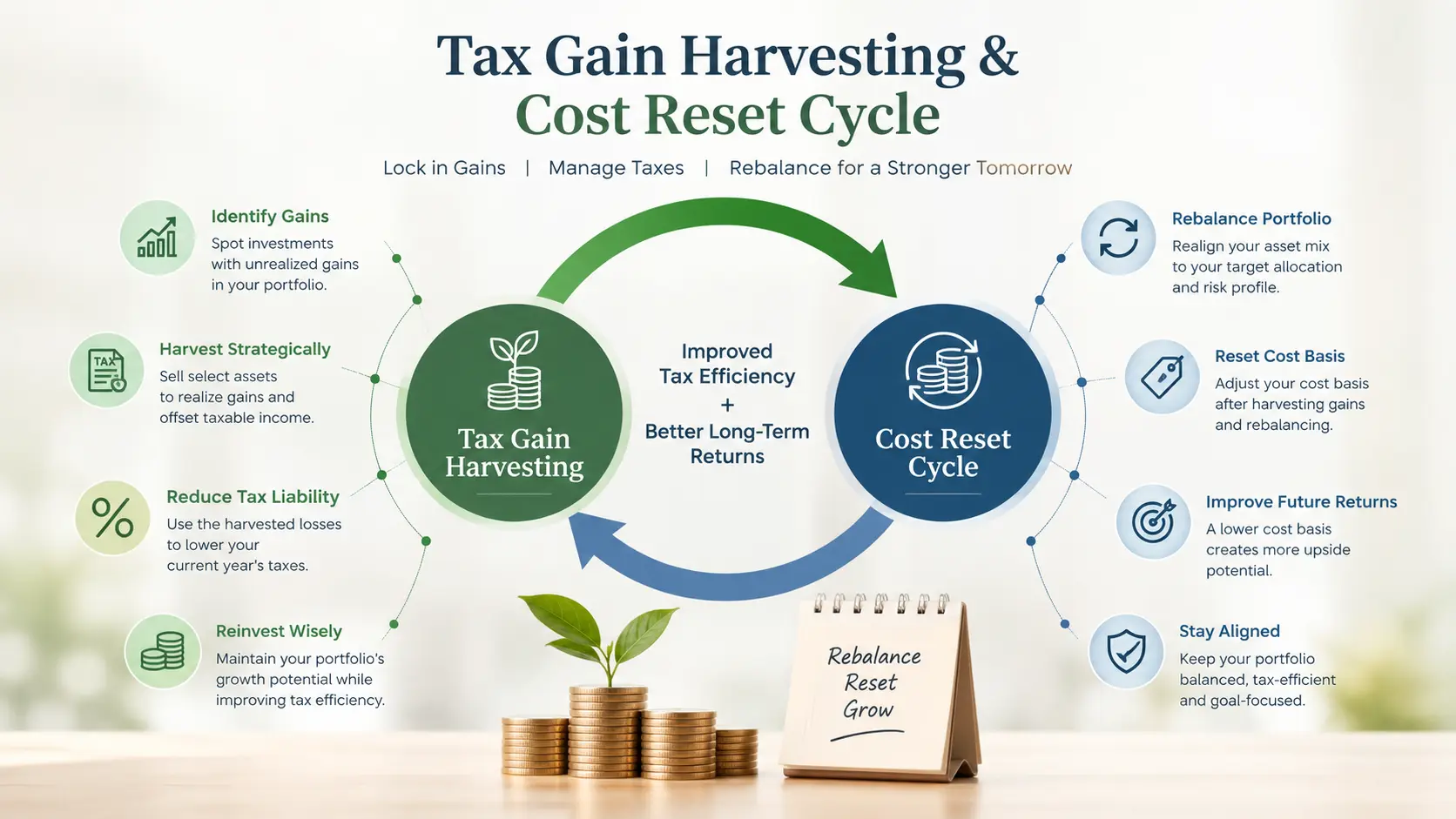
Tax harvesting is not only about loss harvesting. You can also use this concept to harvest tax-free gains every year. If you hold listed shares or equity mutual funds, your long-term capital gains are taxed at 12.5 percent beyond 1,25,000 rupees. The 1,25,000 rupees exemption can be used every year and it is a use-it-or-lose-it exemption. Any profit that you make on these listed shares beyond 1,25,000 rupees would be taxed at 12.5 percent.
If you have unrealized long-term profits in your portfolio, you can do a bit of an arbitrage here. You can sell enough shares (in terms of quantity) by 31st March to make a profit of 1,25,000 rupees. Since that profit lies within the tax-free slab, you will have to pay zero tax on it. Immediately the next day, you can buy back those same shares.
By doing this, what you are essentially doing is increasing your cost of acquisition to today's share price. Eventually, when you sell those shares years down the line, you would be able to save 12.5 percent on that lot of shares that you bought back. You can check your exemption limits directly on the Capital Gains Tax Calculator.
The 8-Year Carry Forward Rule: Section 74
What if your capital losses in a particular year surpass your profits? Or what if you had no profits at all in a particular year to adjust your losses against?
Under Section 74 of the Income Tax Act, any unadjusted capital losses (both short-term and long-term) at the end of the financial year can be carried forward for 8 consecutive years. You can actually adjust those unadjusted losses in the future years against the capital gains that you make in those years.
However, under Section 139(3) of the Income Tax Act, you have to file your Income Tax Return on or before the due date. If you file a late or belated return after the due date, you cannot carry forward any losses.
Step By Step Guide for the Actions to be Taken Before March 31
- Action 1: Download your Tax P&L statement from your broker console (e.g. Zerodha, Groww, Upstox, etc.) and have a quick glance at your net realized short-term and long-term gains for the year.
- Action 2: Scan through your portfolio to find fundamentally broken stocks or portfolios that are lagging behind the market and you are sitting with substantial unrealized losses.
- Action 3: Calculate how much you need to harvest in order to wipe off your high-tax short-term gains and high-tax long-term gains (profits exceeding 1,25,000) using the Capital Gains Tax Calculator.
- Action 4: Sell the required quantity of shares via delivery orders before the last trading day of March.
- Action 5: If you still believe in the long-term prospects of the company/sector, you can buy it back the next day or park your capital in a similar ETF.
- Action 6: Always verify the transactions in your Annual Information Statement (AIS) and Taxpayer Information Summary (TIS) before filing your ITR-2 or ITR-3 by the due date of July 31.
Conclusion
Tax loss harvesting is a practice that is done by institutional investors and the super-rich to keep their hard-earned money in their pocket. By taking advantage of Sections 70, 74 and the annual 1.25 lakh rupees exemption, you can actually convert losses into an advantage and make your wealth creation journey a little bit faster. Explore our complete suite of Financial & Investment Calculators to optimize your portfolio compounding.

Valuenomy Research
Capital Markets & Valuation DeskValuenomy Research Desk is comprised of certified financial analysts focusing on DCF valuation modeling, Indian direct taxation analysis, and quantitative equity risk management.
View Editorial Profile & MethodologyRegulatory Compliance & Statutory Disclaimer
The financial models, valuation projections, brokerage summaries, and target estimations presented on Valuenomy are curated solely for academic research, mathematical evaluation, and investor education purposes.
Valuenomy is not a SEBI-registered investment advisor or research analyst. Securities markets are subject to high market risks. Always review underlying corporate filings and consult an authorized SEBI-registered financial advisor before executing capital decisions.