Statutory Auditor Resignation: The 5-Day Warning Signal Before Stock Crashes
- Valuenomy Research
- Regulatory & SEBI
- 15 Sep, 2026
Statutory auditor resignations are more ominous to retail shareholders than bad quarterly results. Even though promoters and exec managements can fabricate convenient stories around inventory build-up, lower receivables, or delayed cash collection, there is little legal leeway for corporate managements to rationalize the exit of the independent professional legally entrusted to cross-verify their accounts.
An independent audit provides the foundation of corporate credibility. Statutory auditors enjoy free and open access to the company’s finances per Sections 139 and 143 of the Companies Act, 2013. Auditors resign when the threat to legal, reputational, and regulatory liabilities of signing off on a company’s balance sheet outweighs the commercial benefits of sticking to the engagement.
A mid-term statutory auditor resignation rarely is benign for retail shareholders. Historically, in Indian capital markets, it is a five-day warning signal preceding steep market drawdowns, credit rating downgrades, and regulatory interventions.
Statutory and Regulatory Framework Governing Statutory Auditor Resignations
To understand the significance of a statutory auditor resignation, one needs to understand the statutory obligations of companies post-resignation.
As per Section 140 Sub-section 2 read with Rule 8 of Companies (Audit and Auditors) Rules, 2014, a resigning auditor is bound to inform the Registrar of Companies (ROC) by filing Form ADT-3 within thirty days of the date of resignation. In this filing, the auditor is legally bound to narrate the specific reasons and pertinent facts leading to the resignation.
As per Section 140 Sub-section 3, if an auditor fails to file Form ADT-3, monetary penalties are payable directly to the auditing firm.
Listed entities, on the other hand, have more onerous requirements. As per Regulation 30 read with Clause A of Part A of Schedule III of SEBI Listing Obligations and Disclosure Requirements (LODR) Regulations, 2015, listed companies are mandated to disclose the reasons for a statutory auditor resignation to the stock exchanges as soon as possible but not later than twenty-four hours from receipt of the resignation letter.
Following widespread governance breakdowns where auditors walked out weeks ahead of annual results, SEBI issued its landmark Circular CIR/CFD/CMD1/114/2019 dated October 18, 2019, putting forward specific conditions:
- If a statutory auditor resigns within forty-five days from the end of a quarter of a financial year, the auditor is mandated to, before resigning, issue the limited review or audit report for that particular quarter.
- If a statutory auditor resigns more than forty-five days from the end of a quarter, they are expected to issue the limited review or audit report for that quarter and the subsequent quarter.
- If the auditor has already issued review reports for the first three quarters of a financial year, they cannot simply vacate but are bound to issue the audit report for the fourth quarter as well as the annual financial statements before their resignation takes effect.
The resigning auditor is required to submit a detailed declaration as per Annexure A indicating whether:
- Management imposed limitations on audit scope,
- Critical accounting information was withheld,
- And alternative audit procedures under Standard on Auditing (SA) 705 Revised were attempted.
As per the Companies (Auditor’s Report) Order (CARO) 2020, Clause xviii, the incoming statutory auditor is required to evaluate and explicitly report whether they have considered the issues, objections, or concerns raised by the outgoing auditor. Per Section 132 of the Companies Act, 2013, the National Financial Reporting Authority (NFRA) continuously monitors audit quality and penalizes auditors who fail to flag fraud under Section 143 Sub-section 12. As a consequence of NFRA scrutiny, auditing firms opt to resign rather than lose their operating licenses by validating aggressive or manufactured accounts.
Decoding the Public Excuses Versus Forensic Reality
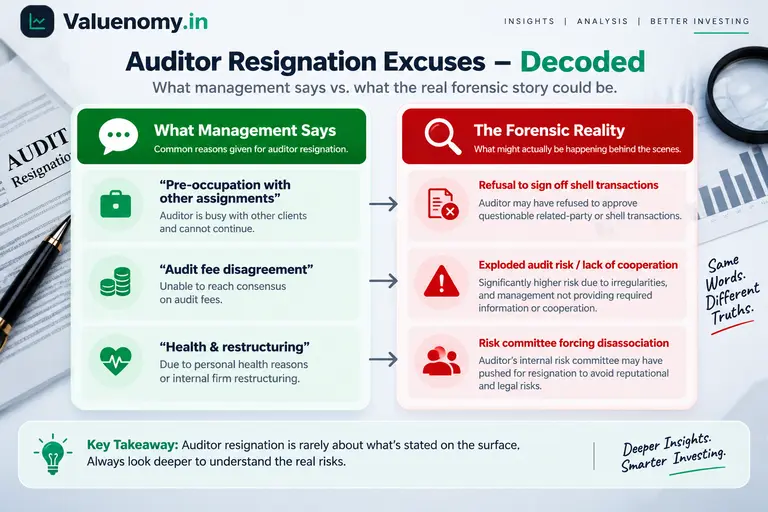
When a listed entity issues an exchange filing regarding a statutory auditor resignation, the official explanation rarely says something like doctored financial records or funds misappropriated. Corporate secretarial filings use carefully crafted polite euphemism. Investors need to decode these euphemisms against actual forensic realities:
Excuse 1: Resignation due to pre-occupation with other professional assignments.
Forensic Reality: Professional audit firms work on an annual planning cycle and rarely walk out mid-terms. Pre-occupation is the euphemism used whenever the auditor refused to sign off on unverifiable entries, like unconfirmed trade receivables or doubtful advances to shell entities.
Excuse 2: Inability to agree on mutual audit fee revisions or commercial terms.
Forensic Reality: Auditing firms seldom walk away from an existing client on a mid-term basis strictly on disagreement of fees unless the audit risk has exploded manifold, demanding hundreds of additional forensic testing hours the management is not willing to compensate or authorize.
Excuse 3: Non-receipt of sufficient and appropriate audit evidence regarding subsidiary books.
Forensic Reality: This is the most transparent warning bell under SEBI Annexure A. When the management fails to produce bank confirmations, access to physical inventory count, or overseas subsidiary ledgers, the auditor is protecting themselves from legal prosecution by certifying ghost balances.
Excuse 4: Health issues or restructuring of the engagement partner firm.
Forensic Reality: Individual partners may change, but the audit firm legally holds the statutory mandate. Citing health or internal restructuring to vacate a listed mandate indicates internal risk-management committees forcing the audit team to dissociate from an unmanageable governance profile.
The 5-Day Forensic Cascade and Price Action Collapse
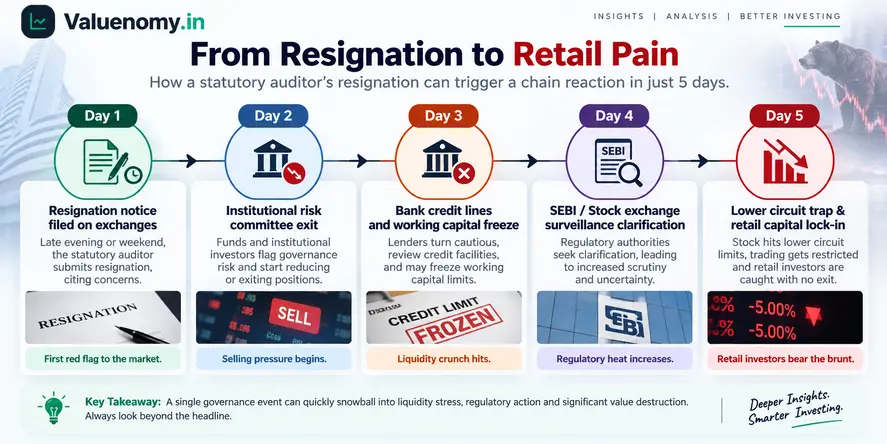
A statutory auditor resignation triggers a distinct mechanical sequence across institutional desks and trading floors:
Day 1: The Resignation Notice and Information Vacuum
The company files an exchange disclosure, occasionally late in the evening or over a weekend. Retail market participants see the brief headline as a procedural change, but algorithmic institutional screeners instantly flag the mandate break.
Day 2: Institutional De-risking and Risk Committee Reviews
Mutual funds, foreign portfolio investors, and portfolio management services have strict internal risk mandates that trigger automatic sell reviews or immediate liquidation mandates whenever a statutory auditor steps down prematurely. Institutional trade desks begin aggressive selling into market depth.
Day 3: Working Capital and Credit Facility Freezes
Banking consortia monitor corporate disclosures through credit monitoring units governed by Reserve Bank of India (RBI) Prudential Norms. A sudden auditor exit raises immediate credit scrutiny. Bankers frequently freeze incremental drawing limits against book debts or demand enhanced collateral, starving the firm of operating liquidity.
Day 4: Regulatory Inquiries and Forensic Scrutiny
SEBI surveillance teams and stock exchange compliance divisions issue administrative clarifications seeking unedited copies of the auditor correspondence, Form ADT-3 filings, and audit committee minutes. Market rumors compound, and short sellers aggressively target the company’s valuation.
Day 5: Downward Circuit Traps and Permanent Capital Impairment
By the fifth trading session, retail panic selling collides with zero institutional buy orders. The stock routinely hits downward circuit filters, trapping investors who delayed their exit. Over the following six to twelve months, previous earnings are frequently restated downward, leading to catastrophic capital erosion.
Data Comparison Across Corporate Profiles
| Parameter | Profile A: Genuine Corporate Reorganization (Clean Governance) | Profile B: Mid-Term Forensic Breakdown (High Danger) |
|---|---|---|
| Auditor Tenure | Completed full five-year mandatory rotation cycle under Section 139 Sub-section 2. | Resigned in Year 2 of a five-year term, thirty days before Q4 annual reporting. |
| Timing of Departure | Concluded at the Annual General Meeting following adoption of audited annual accounts. | Sudden exit with no preliminary warnings on exchange channels. |
| Form ADT-3 Disclosure | Plain rotation compliance with no adverse observations. | Explicit notes regarding non-availability of management records and unconfirmed inter-corporate deposits. |
| Exchange Notice | Disclosed alongside incoming auditor profile with joint handover notes. | Cites pre-occupation and commercial differences under Annexure A. |
| Subsequent Price Impact | Negligible volatility or stable compounding. | Stock collapsed by 65 percent over the following three quarters, followed by forensic investigations and delisting threats. |
Investor Action Framework and Portfolio Protection
Retail investors must implement an institutional de-risking protocol the moment an announcement appears:
- Step 1: Download Form ADT-3 and SEBI Annexure A immediately.
Do not rely on the brief headline in corporate press releases. Access the BSE or NSE corporate announcement section and inspect the full resignation letter, Annexure A details, and Audit Committee deliberations. - Step 2: Scrutinize CARO 2020 and SA 705 disclosures.
Check if the auditor previously recorded a qualified opinion, an adverse opinion, or a disclaimer of opinion. If the outgoing auditor mentions scope limitations, exit the position without debating turnaround potential. - Step 3: Track the replacement auditor’s credentials.
When an established, top-tier accounting firm resigns, observe who takes over the mandate. If an unknown, sole-proprietor firm operating out of a residential location is appointed within days to audit a multi-thousand-crore enterprise, the governance risk is catastrophic. - Step 4: Recompute realistic intrinsic valuation.
Unverified accounting figures invalidate previous financial projections. Investors should re-run valuation scenarios on Valuenomy’s Fair Value Calculator, stripping away reported paper margins and modeling significant forensic discounts to establish true downside floors.
Sources
- https://www.mca.gov.in
- https://www.sebi.gov.in
- https://nfra.gov.in
- https://www.icai.org
- https://www.rbi.org.in
Frequently Asked Questions
What is Form ADT-3 in an auditor resignation?
Form ADT-3 is a mandatory statutory filing submitted by a resigning auditor to the Registrar of Companies (ROC) within thirty days detailing the specific reasons for stepping down.
Can a statutory auditor resign without giving a reason?
No, the Companies Act and SEBI regulations legally mandate the auditor to provide detailed reasons, and withholding them incurs severe personal fines and professional penalties.
Why do auditor resignations happen mostly before fourth quarter results?
Auditors face severe legal liability when signing full-year balance sheets, prompting exits when management cannot substantiate annual inventory, receivables, or debt numbers.
Does SEBI allow an auditor to resign immediately during a quarter?
Under SEBI rules, if an auditor resigns within forty-five days from a quarter’s end, they must finish and issue the review report for that quarter before leaving.
What is the biggest red flag in an auditor resignation letter?
The most critical red flag is a statement citing management-imposed limitations on audit scope or failure to receive critical financial evidence regarding subsidiaries.

Valuenomy Research
Capital Markets & Valuation DeskValuenomy Research Desk is comprised of certified financial analysts focusing on DCF valuation modeling, Indian direct taxation analysis, and quantitative equity risk management.
View Editorial Profile & MethodologyRegulatory Compliance & Statutory Disclaimer
The financial models, valuation projections, brokerage summaries, and target estimations presented on Valuenomy are curated solely for academic research, mathematical evaluation, and investor education purposes.
Valuenomy is not a SEBI-registered investment advisor or research analyst. Securities markets are subject to high market risks. Always review underlying corporate filings and consult an authorized SEBI-registered financial advisor before executing capital decisions.