STCG vs LTCG on Shares: Rules, Rates & Tax Calculation Guide
- Valuenomy Research
- Regulatory
- 06 Sep, 2026
Understanding the taxation rules on equity investments is one of the most crucial pillars of wealth creation in Indian Financial Markets. While, earning high CAGR on your portfolio is important, there is nothing worse than losing a big chunk of profits due to bad tax-planning and ill-timed trades.
With the recent major rationalization of the direct tax system in India in 2022, taxation rules for Short-Term Capital Gains (STCG) and Long-Term Capital Gains (LTCG) from listed shares and mutual-funds have changed fundamentally. Investors are advised understand the revised STCG and LTCG tax rules and utilize various legal tax-saving provisions to the maximum extent possible.
Overview of Capital Gains Tax in India
Profits or gains arising from the transfer of a capital asset are chargeable to capital gains tax in India.
Since gains from sale of shares and mutual-funds are not considered to be part of an individual's salary or revenue by the Income Tax Department (ITD), they are taxed at Special Rates under separate sections of the Income Tax Act.
Capital Gains on Equity Shares are classified into two categories depending on the period of ownership by the shareholder:
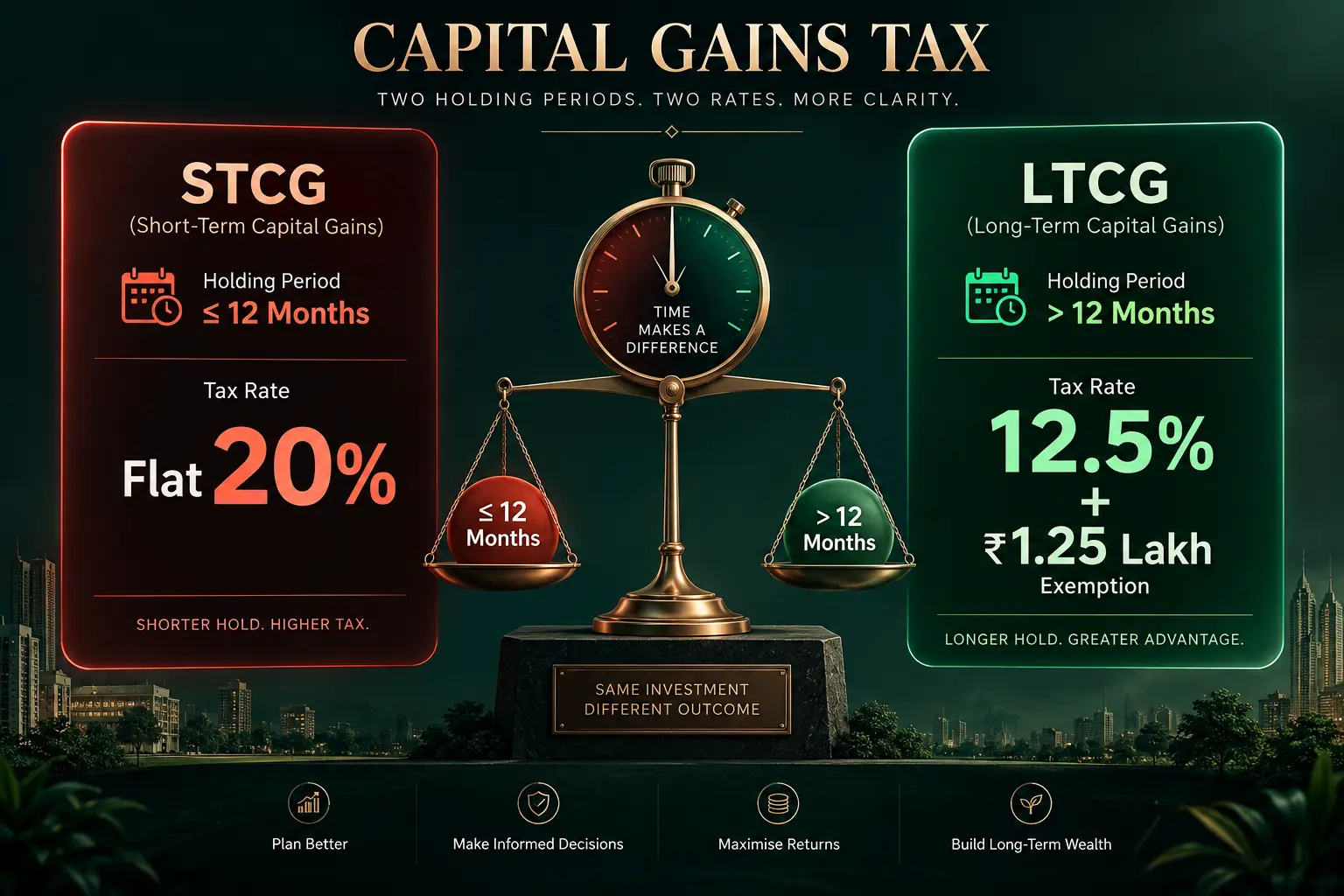
Short-Term Capital Gains (STCG): Profit arising from sale of an equity share before the expiry of the minimum period of holding (12 months).
Long-Term Capital Gains (LTCG): Profit arising from sale of an equity share after the expiry of the minimum period of holding (12 months).
Let us now understand various other related concepts including calculation of STCG and LTCG, exemption thresholds, loss set-off rules and methods to save taxes while booking profits on equity shares, equity mutual funds and other assets.
STCG vs LTCG in India – Complete Reference Table 2026
The reference table below provides a comprehensive overview of various tax aspects applicable to equity shares, mutual funds, real-estate, gold and other assets.
| Sr.No | Particulars | Short-Term Capital Gains (STCG) | Long-Term Capital Gains (LTCG) |
|---|---|---|---|
| 1 | Holding Period | Listed Shares, Equity Mutual Funds – 12 months or less | Listed Shares, Equity Mutual Funds – More than 12 months |
| 2 | Tax Section Applicable | 111A | 112A |
| 3 | Tax Rate | 20% | 12.5% |
| 4 | Annual Exemption | ₹0 | ₹1,25,000 (Sec 112A) |
| 5 | Applicable Cess | 4% | 4% |
| 6 | Effective Tax Rate | 20.80% (20% + 4% Cess) | 13% (12.5% + 4% Cess) |
| 7 | Indexation Benefit | Not Applicable | Not Applicable |
| 8 | Securities Transaction Tax (STT) | Applicable | Applicable |
| 9 | Section 87A Rebate | Not Applicable | Not Applicable |
| 10 | Loss Adjustment | Can offset both STCG & LTCG | Only Against LTCG |
| 11 | Holding Period Rules | Refer Below | Refer Below |
STCG vs LTCG – Holding Period Rules
A common doubt that arises among retail investors pertains to the discrepancy in the long-term holding period for various assets. Under the rationalized regime, all long-term holding periods are classified into either 12 months or 24 months depending on the nature of the asset.
Applicable to Listed Shares and Mutual Funds Schemes:
In case of shares bought on recognized stock exchanges such as BSE, NSE and mutual fund schemes (with more than 65% equity exposure), the long-term holding period is of 12 months. This also applies to Business Trusts such as REITs and InvITs, and Exchange-Traded Funds (ETFs)
Note: If you sell listed shares or mutual funds on day 365 (exactly 1 year), your entire profit on sale would be taxed as STCG at 20%. However, for the same shares held till day 366 (more than 1 year), you stand to benefit by paying LTCG tax at 12.5% without having to pay any indexation.
Applicable to Unlisted Shares, Gold, Real Estate:
For all other assets such as unlisted shares, gold and real estate, the long-term holding period is of 24 months.
Applicable to Debt Mutual Funds:
For debt mutual funds with a portfolio exposure of less than 35% in domestic equity purchased on or after April 1, 2023, the long-term capital gains tax has been abolished by the Union Budget 2023. All gains arising from the sale of such assets would be taxed at the investor's applicable income tax slab rate on a short-term basis.
STCG and LTCG Calculation – With Examples
Let us look at an example to understand how the tax is calculated on STCG & LTCG:
Example A: STCG of ₹3,00,000 (Short-Term Gain)
Let us assume that you had bought 500 shares of a company at ₹1,000 each for total outlay of ₹5,00,000. After 7 months, you sold the same shares at ₹1,600 each for total sale proceeds of ₹8,00,000
| Particulars | Amount (₹) |
|---|---|
| Sale Proceeds (500 X 1,600) | 8,00,000 |
| Minus: Cost of Purchase (500 X 1,000) | (5,00,000) |
| Short-Term Capital Gains | 3,00,000 |
| Minus: Annual LTCG Exemption (Section 112A) | (Nil) |
| Taxable Short-Term Capital Gains | 3,00,000 |
| Tax @ 20% (3,00,000 X 20%) | 60,000 |
| Plus: 4% Health & Education Cess (60,000 X 4%) | 2,400 |
| Total Tax Liability | 62,400 |
| Net Take-Home Profit after Tax | 3,00,000 – 62,400 = 2,37,600 |
| Effective Tax Rate | 20.80% |
Example B: LTCG of ₹3,00,000 (Long-Term Gain)
Assuming the same facts as Example A, however with the modification that you sold the shares after 14 months instead of 7 months:
| Particulars | Amount (₹) |
|---|---|
| Sale Proceeds (500 X 1,600) | 8,00,000 |
| Minus: Cost of Purchase (500 X 1,000) | (5,00,000) |
| Long-Term Capital Gains | 3,00,000 |
| Minus: Annual LTCG Exemption (Section 112A) | (1,25,000) |
| Taxable Long-Term Capital Gains | 1,75,000 |
| Tax @ 12.5% (1,75,000 X 12.5%) | 21,875 |
| Plus: 4% Health & Education Cess (21,875 X 4%) | 875 |
| Total Tax Liability | 22,750 |
| Net Take-Home Profit after Tax | 3,00,000 – 22,750 = 2,77,250 |
| Effective Tax Rate | 7.58% |
Conclusion:
By waiting for an additional 7 months to let the LTCG exemption of ₹1.25 Lakh kick-in, you were able to reduce your tax liability by ₹39,650 or 63.5% without adversely affecting your overall gains. You can similarly utilize the LTCG exemption limit to minimize your tax burden while booking profits on equity shares and mutual funds.
Pro Tip: You can use our Capital Gains Tax Calculator to analyze and compare tax implications from various block sales and systematic purchase options such as SIPs.
Overview of ₹1.25 Lakh Annual LTCG Exemption Threshold
The ₹1.25 Lakh exemption has been one of the most sought-after benefits for Indian investors that has been introduced by the Union Budget 2022. Here are 3 things that you must know about the LTCG exemption threshold:
1. ₹1.25 Lakh is a Cumulative Limit for Listed Equity Shares and Mutual Funds:
The exemption threshold of ₹1.25 Lakh is clubbed together for all of your long-term gains from equity shares and equity mutual funds. Therefore, if you hold shares in multiple companies, the gains from the sale of all such assets would be aggregated to determine whether you would be eligible for the ₹1.25 Lakh LTCG exemption or not.
2. LTCG Exemption Cannot be Carried Forward:
The LTCG exemption of ₹1.25 Lakh is a one-time annual benefit which has to be claimed within a financial year. It cannot be carried forward to succeeding years.
3. LTCG from Listed Equity Shares are Not Subject to Indexation:
The gains from the sale of listed equity shares are taxed on a notional price difference (NPD) basis and therefore no indexation benefits are available.
Strategies to Save Taxes on Equity Mutual Funds and Shares
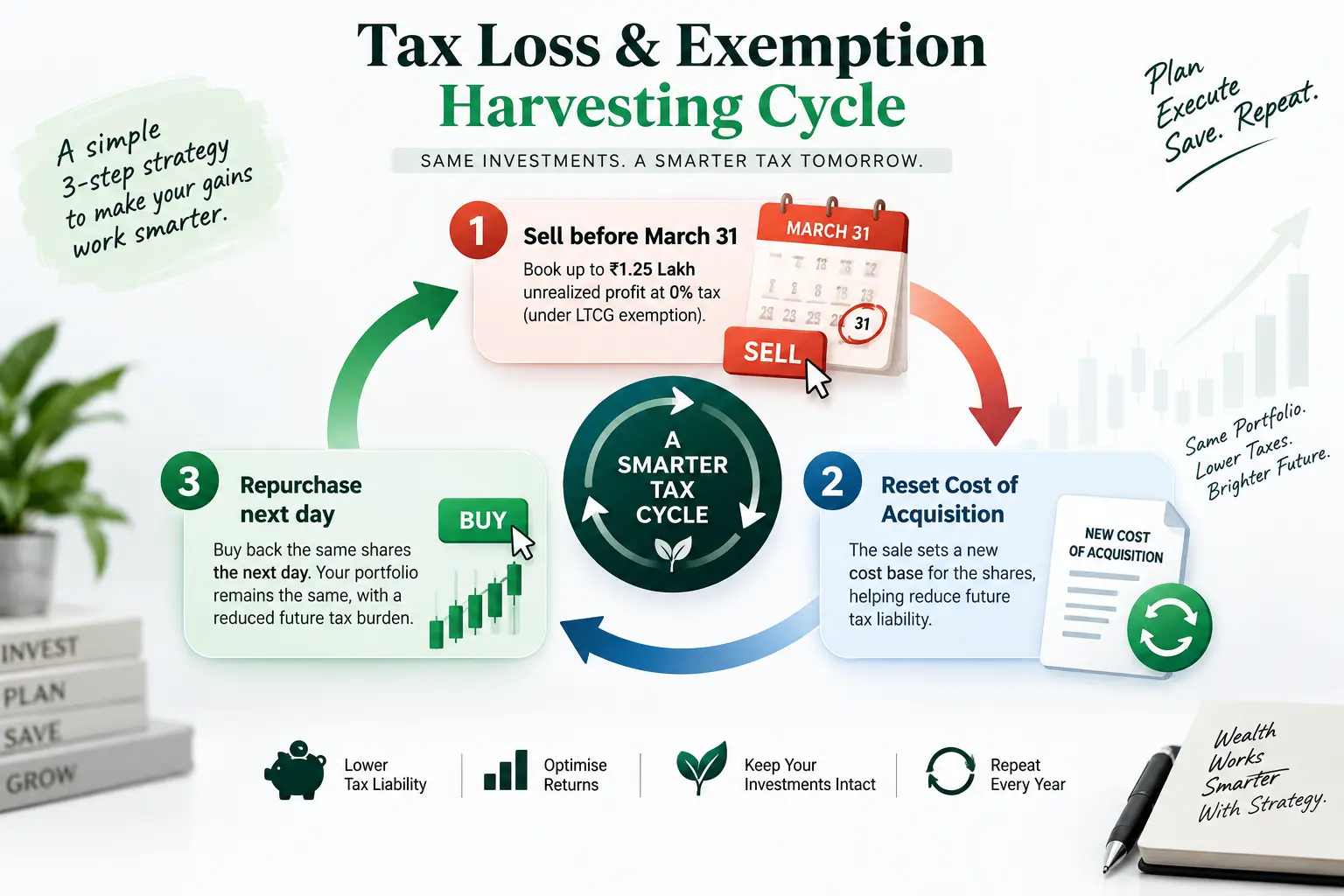
Like any other aspect of personal finance, taxes on equity shares are a choice. Tax-loss harvesting and LTCG exemption harvesting are some of the effective ways to reduce your tax liability on equity shares.
1. LTCG Exemption Harvesting:
Since the LTCG exemption is a one-time annual benefit which has to be claimed within a financial year, it is better to sell off shares that you do not intend to hold in the future to ensure that you utilize the exemption threshold. This is especially true if the sale would result in gains of more than ₹1.25 Lakh as you would be able to save additional tax on gains up to ₹1.25 Lakh.
Strategy:
Identify shares or mutual funds with unrealized gains close to ₹1.25 Lakh. Sell the asset before the end of the Financial Year to claim exemption under Section 112A. The same shares can then be repurchased the following day to ensure that you do not permanently book gains on the shares. This way, whenever you finally sell the shares in the future, your cost of purchase would have increased accordingly and therefore your capital gains would reduce.
2. Tax Loss Harvesting:
If you have made profits on short-term trading during the year and your trading account statement shows a credit of ₹1,50,000, it would result in a tax liability of ₹31,200 (20.80% tax on ₹1,50,000). You can utilize the tax-loss harvesting strategy to reduce the tax liability on short-term trading profits.
Strategy:
Identify shares that you are willing to sell at a loss. The loss on sale would be adjusted against your profits on short-term trading to reduce your overall tax liability. For instance, if you sell shares with unrealized loss of ₹1,00,000, it would reduce your short-term trading profits from ₹1,50,000 to ₹50,000 and consequently your tax liability would also decrease from ₹31,200 to ₹10,400 (20.80% tax on ₹50,000). Therefore, by using the tax-loss harvesting strategy, you would be able to save ₹20,800 on your tax bill.
Loss Set-Off and Carry Forward Rules
The Income Tax Act provides relief to taxpayers in case of losses arising from the sale of capital assets. However, there are certain rules that specify how such losses can be set-off and adjusted against gains.
The table below provides a brief overview of the loss set-off rules for STCG and LTCG:
| Loss Type | Adjustable Against… |
|---|---|
| Short-Term Loss (STCL) | Short-Term Gain (STCG) AND Long-Term Gain (LTCG) |
| Long-Term Loss (LTCL) | Long-Term Gain (LTCG) ONLY |
Adjustment Rules for Short-Term and Long-Term Losses:
1. Set-Off Against Gains:
Both Short-Term Loss (STCL) and Long-Term Loss (LTCL) can be adjusted against gains as described in the table above. Short-Term Loss can offset both Short-Term and Long-Term Gains, whereas Long-Term Loss can only be adjusted against Long-Term Gains.
2. Carry-Forward of Losses:
If the losses are higher than the gains in a particular financial year, they can be carried forward to the subsequent years. Such losses can be adjusted against future gains in accordance with the loss-set-off rules mentioned above.
3. Loss Carry-Forward Period:
The Income Tax Act allows a taxpayer to carry forward capital losses for a period of 8 years from the relevant assessment year.
4. Filing of Income Tax Return (ITR):
To claim adjustment of losses, the taxpayer must file his or her Income Tax Return (ITR) on or before the due date. If a taxpayer files his ITR under a belated return (Section 139(4)), he would not be able to carry forward his losses to succeeding years.
8 Most Common Doubts about Capital Gains Tax
1. What is the STCG and LTCG tax rate for shares in India?
Short-Term Capital Gains (STCG) on equity shares are taxed at 20% plus 4% cess, whereas Long-Term Capital Gains (LTCG) are taxed at 12.5% plus 4% cess.
2. Can I adjust my capital loss against my salary income?
No. Capital losses can only be adjusted against capital gains and not against any other source of income, including salary.
3. Does the ₹1.25 Lakh LTCG exemption apply to each share or mutual fund or it is a combined limit?
No. The ₹1.25 Lakh LTCG exemption is a combined limit for all your long-term capital gains arising from the sale of equity shares and equity mutual funds.
4. Can I claim indexation benefit on LTCG from shares?
No. LTCG on shares are taxed on notional price difference (NPD) basis and therefore benefit of indexation is not available.
5. How are Systematic Investment Plans (SIPs) taxed in India?
Each installment of a SIP is treated as a separate investment with the respective cost of acquisition and period of holding. For instance, if you start a SIP for 24 months and then redeem the entire amount on the 24th month, only the first 12 installments will be eligible for LTCG exemption of ₹1.25 Lakh and taxed at 12.5%. The last 12 installments will be treated as short-term and taxed at 20%.
6. Can Non-Resident Indians (NRIs) claim ₹1.25 Lakh LTCG exemption?
Yes. The ₹1.25 Lakh LTCG exemption is applicable to residents & NRIs in India.
Capital Gains Tax Tips and Recommendations
To summarize everything discussed above, here are some quick actionable insights for equity investors:
- Track Holding Periods Closely: All things remaining constant, it is always better to hold on to quality stocks for more than 12 months to reduce your tax liability from 20.8% to 13%.
- Harvest LTCG Exemption Every Year: Try and utilize your ₹1.25 Lakh LTCG exemption every year to reduce your tax liability. This will also help in adjusting the cost basis of your shares.
- Book Losses Before March 31: Use the tax-loss harvesting strategy to adjust losses against short-term trading profits and reduce your overall tax liability.
- File Tax Returns Before Due Date: Always file your tax returns before the due date to ensure that you have the option to carry forward your losses in case of any unadjusted capital losses.
- Simulate Tax Liability Before Making Large Buys or Sells: It is critical to estimate your tax liability before making large block sales or purchases. You can use our free online Capital Gains Tax Calculator and SIP & Lumpsum Calculator to simulate the impact of STCG and LTCG on your overall profit and tax liability.

Valuenomy Research
Capital Markets & Valuation DeskValuenomy Research Desk is comprised of certified financial analysts focusing on DCF valuation modeling, Indian direct taxation analysis, and quantitative equity risk management.
View Editorial Profile & MethodologyRegulatory Compliance & Statutory Disclaimer
The financial models, valuation projections, brokerage summaries, and target estimations presented on Valuenomy are curated solely for academic research, mathematical evaluation, and investor education purposes.
Valuenomy is not a SEBI-registered investment advisor or research analyst. Securities markets are subject to high market risks. Always review underlying corporate filings and consult an authorized SEBI-registered financial advisor before executing capital decisions.